Sakamoto Minoru
Memoirs of a GeishaSakamoto Minoru is Chiyo and Satsu’s father, a fisherman whose steadfastness is associated with wood and the sea. His history includes the deaths of his first wife and two young sons; later, when Mr. Tanaka proposes taking his daughters away, Minoru’s inability to picture them living elsewhere gives way to a silent assent. That restrained decision marks the threshold between the girls’ family life and their departure from home.
Identity and Background
Minoru’s character is described through the elemental vocabulary his wife uses to explain their marriage: she has too much water in her personality, while he has too much wood. Water moves readily and finds openings; wood holds fast to the earth. For Minoru, that rooted quality fits his work as a fisherman. He is more at ease at sea than anywhere else and, even after bathing, carries its smell with him.
His life at home is defined by the same deliberate steadiness. When he is not fishing, he sits in the dark front room mending a net, working so slowly and carefully that even the imagined sleeping creature in the net would not be woken. His face, deeply creased with worries, is likened to a tree crowded with nests; maintaining an expression of concentration seems to cost him effort.
Bereavement and Family
When Chiyo asks why he is so old, Minoru can only answer that he does not know. The following day, her mother takes her to a graveyard in the woods and shows her three markers: Natsu, Minoru’s first wife, who died at twenty-four, and their sons Jinichiro and Masao, who died at six and three. All three deaths are dated to Meiji 19. Chiyo gradually understands that her father had lost an entire family before his present one.
The graves make bereavement physical in Chiyo’s memory: standing among them, she feels suddenly twice as heavy, as if the dead were pulling her down. Minoru’s history of loss is thus revealed not through an account from him but through the child’s encounter with the family markers. The scene gives his quietness a painful context while leaving his own response to those earlier deaths unstated.
In his second family, the daughters seem to embody the different temperaments of their parents. Chiyo resembles her mother, including her unusual gray eyes, while Satsu resembles Minoru. The contrast turns the parents’ elemental pairing into a family pattern, though the account does not reduce Minoru to that symbolism: his work, grief, and eventual decision all belong to the material circumstances of the household.
The Proposal and Departure
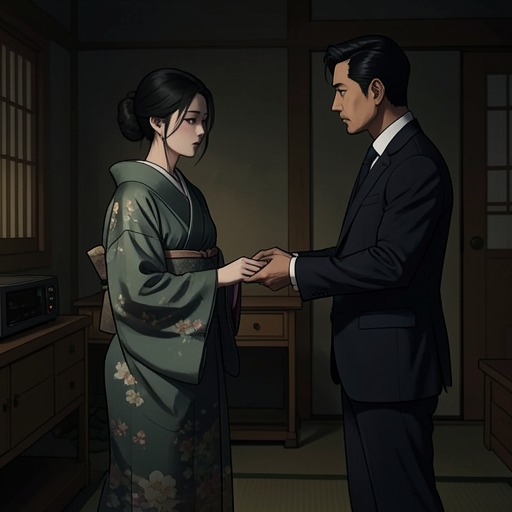
Chiyo’s distress leads her to imagine that Mr. Tanaka might adopt her. A week or so after those fantasies begin, she returns home and finds him seated across from Minoru at the family’s small table. Their conversation is serious enough that neither notices her in the entryway. Mr. Tanaka asks what Minoru thinks of his proposal; Minoru answers that he cannot picture the girls living anywhere else.
The hesitation is the clearest expression of his attachment to his daughters, but it does not become a refusal. Later, when Chiyo tells him that Mr. Tanaka wants her and Satsu to go down to the village, Satsu removes her apron and walks out. Minoru does not answer. He blinks, looks toward the place where Satsu stood, then lowers his eyes to the floor and nods. From the back room, Chiyo hears her mother cry out in her sleep.
Narrative Role and Significance
Minoru’s importance lies partly in the contrast between his rootedness and the movement that carries his daughters away. The fisherman who is most at ease on the sea is nevertheless reluctant to imagine his children living anywhere but home. His final nod is not explained in words, and the narrative does not disclose what he thinks as Satsu leaves; its force comes from that silence, the daughter’s departure, and the cry from the sickroom.
The account also makes family history part of the girls’ separation: before Minoru’s present household can be broken apart, Chiyo learns that he has already endured the loss of a wife and two sons. His character is therefore shaped by two kinds of absence—the family buried in the woods and the daughters he lets go—without the text claiming that one alone explains the other.